Black Sigil: Finding Fun in a Flawed Game, 15 Years Late
Have you ever seen a game, forgotten about it, then stumbled upon it again years later? This happened to me with Black Sigil. 15 years ago this game was kind of unplayable. Today, it's a gem.
The 2004 release of the Nintendo DS couldn't have been more perfectly timed for me. It was my senior year at university and I was emerging from a lengthy absence from all things pop culture. I spent the summer catching up on the books, movies, and video games I had missed, which meant buying a GameCube, watching the second two Matrix movies, and seeing what this Harry Potter nonsense was all about.
My freelance game writing career was in its early stages. I was volunteering with a site that exclusively covered the handheld scene. After class I would rush home, work on whatever Game Boy Advance review I had in the queue, then see what Nintendo DS news had hit so I could stay on the hype train. Not only was I catching up on the gaming industry, but I was just in time for the next big thing.
When the DS was announced everybody was worried Nintendo would drop the Game Boy line. Don't worry, the big N said, this is a third pillar, not a replacement! That lasted all of a year, as the DS took off in a big way and the Game Boy Advance was left to fade. Teams with in-dev Game Boy Advance titles scrambled to switch everything to the new system, tacking on touch controls and filling in second screen content so the games wouldn't feel too out of place.

Black Sigil: Blade of the Exiled was one of these mid-stream ported games. It started in 2003 as an homage to Chrono Trigger, Final Fantasy 3 (6), and other SNES RPGs. Developer Studio Archcraft made the sound decision to modify the game for the DS in 2006, even though it was already 70% complete. This was the expected and the right decision, as most of the player base had already moved to the DS.
But even right decisions can go wrong. Black Sigil's DS initial release window was 2007, which would have been perfect since competing DS RPGs were rare. Unfortunately, it missed that date by two years. By the time it actually hit the DS was swimming in RPGs. Well over 100 by my count, with heavy hitters like Chrono Trigger, Pokemon, Etrian Odyssey, and Final Fantasy to compete with. Black Sigil then took a meek step up to the stage with buggy gameplay, visuals that weren't old enough to be retro-cool and not new enough to be cutting edge, and zero name recognition.
Since I was now part of the "in" crowd for the DS, I followed this news as it happened. And when the game came out, it was pelted by mostly negative critical reviews. I promptly ignored it, a decision that, looking back after finally played it, was both an awful and a wonderful idea.
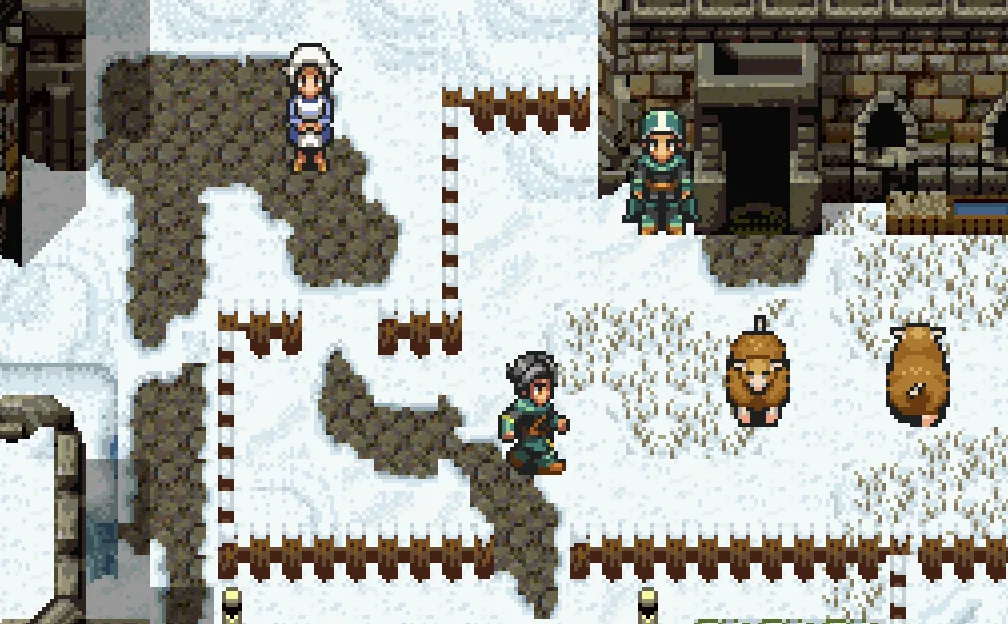
Black Sigil is described as a Chrono Trigger-like RPG, but the only similarities are a surface level art style and dual character battle abilities. There's really nothing else that "feels" like Chrono, so you're better off abandoning the comparison and thinking of the game as a JRPG with tactical battles and a story rooted in magic meets technology. (On that last point, Sigil actually did remind me of the general atmosphere in Illusion of Gaia.)
Most RPGs pick from a bag of tropes to kick things off--the main character getting out of bed, being sent to magic school, having to deal with a sudden disaster, etc. Black Sigil sidesteps that somewhat by opening with two soldiers battling in the way that 16-bit-era characters always battle: sprites bumping into each other. One soldier easily defeats the other, but apparently that was because magic is forbidden in practice bouts. You see, unlike everyone else in the kingdom, our protagonist can't use magic. This inverts the usual trope and makes us bond with the character--he can't use magic and people tease him, I can't use magic either, so I'm like him!
The story moves forward with a balance of not-quite-trite twists and reveals, surprisingly entertaining lore, and characters with simple but believable motivations. There's little in the way of cringe, and dialogue avoids the verbosity trap so many JRPGs fall into. (No, I don't need three text boxes to say 'thank you for buying a potion.') I would definitely call the story a highlight of the experience. It's comfortably above average and one of the game's strongest hooks.
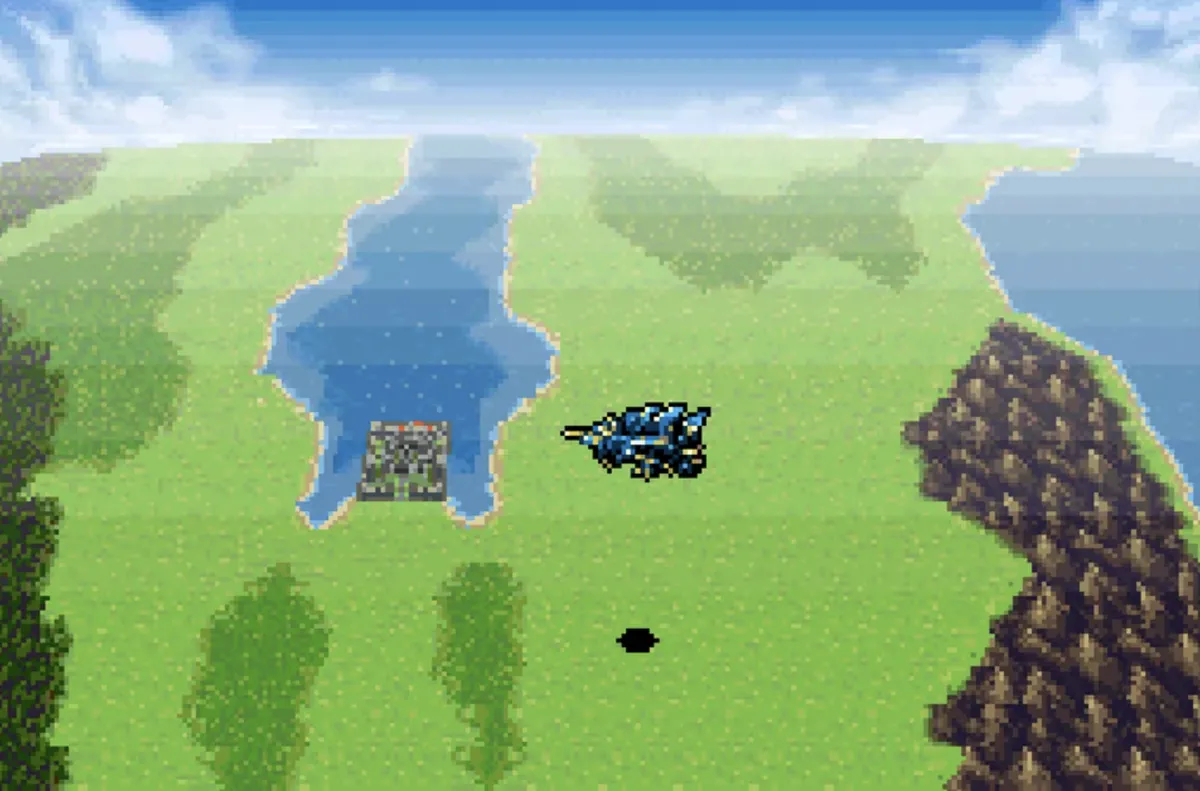
The actual gameplay and mechanics are largely standard RPG fare. You find items and equipment, you visit shops, you speak to townsfolk, you travel through castles and caves, you get into random battles. Black Sigil actively encourages you to seek out forgotten corners and to poke your nose in supposed dead-ends. There are treasure chests you can spot on the edge of the screen, but in order to snag them you'll have to slip behind stones or wiggle through hidden wall gaps. You'll also find pots, barrels, and other bits of scenery that hold prizes, so be prepared to rattle on that A button while dashing around. This is some of my favorite kind of exploration in RPGs, so I was delighted to see Black Sigil lean into it so heavily.
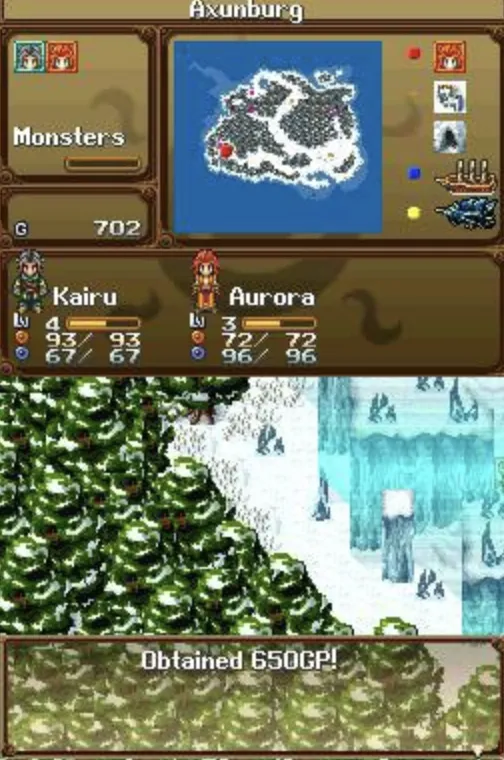
Towns feel enormous and intricate and really encourage you to explore. You won't find tidy streets with grids of well-labelled shops. Instead, expect teleporters and secret shortcuts, shops hiding behind foreground scenery, and multiple tiers of paths to can trod as you zig-zag across the landscape. It's rare that I look forward to towns this much, but when you mix that encouragement to explore with maps like this, it's hard to say no.
Dungeon areas in Black Sigil are similarly organic in layout. They're also brief, simple, and relatively puzzle-free. Unlike some RPGs of the era, you won't need to collect items or a series of keys to unlock doors to progress. Instead, you might have a single screen with cracks in the floor that block your path if you step on them twice, transportation nodules you need to arrange to continue, or game-ending battles if you stray from a path marked with a certain type of sprite. Each "dungeon" only has one of these, and once you pass it, you're essentially in the clear (except for the final boss). Those boss fights are actually pretty interesting and often feature screen-filling pixel art that's a joy to take in.
One downside of this exploration-centric design is the way it fights against the game's detailed artwork. The sprites in Black Sigil are chef's-kiss-good, but because they're so intricate, they often clash with each other in a way that masks walkable paths forward. You'll spend a little too much time pushing against walls just to find out where you can go. Is that a bit of decoration or a stepped path out of the cave? Can you run under that ledge or is it solid? Gotta walk over to find out. It's annoying, but not all that bad...until you figure in the game's worst feature by a mile: an incredibly high encounter rate.
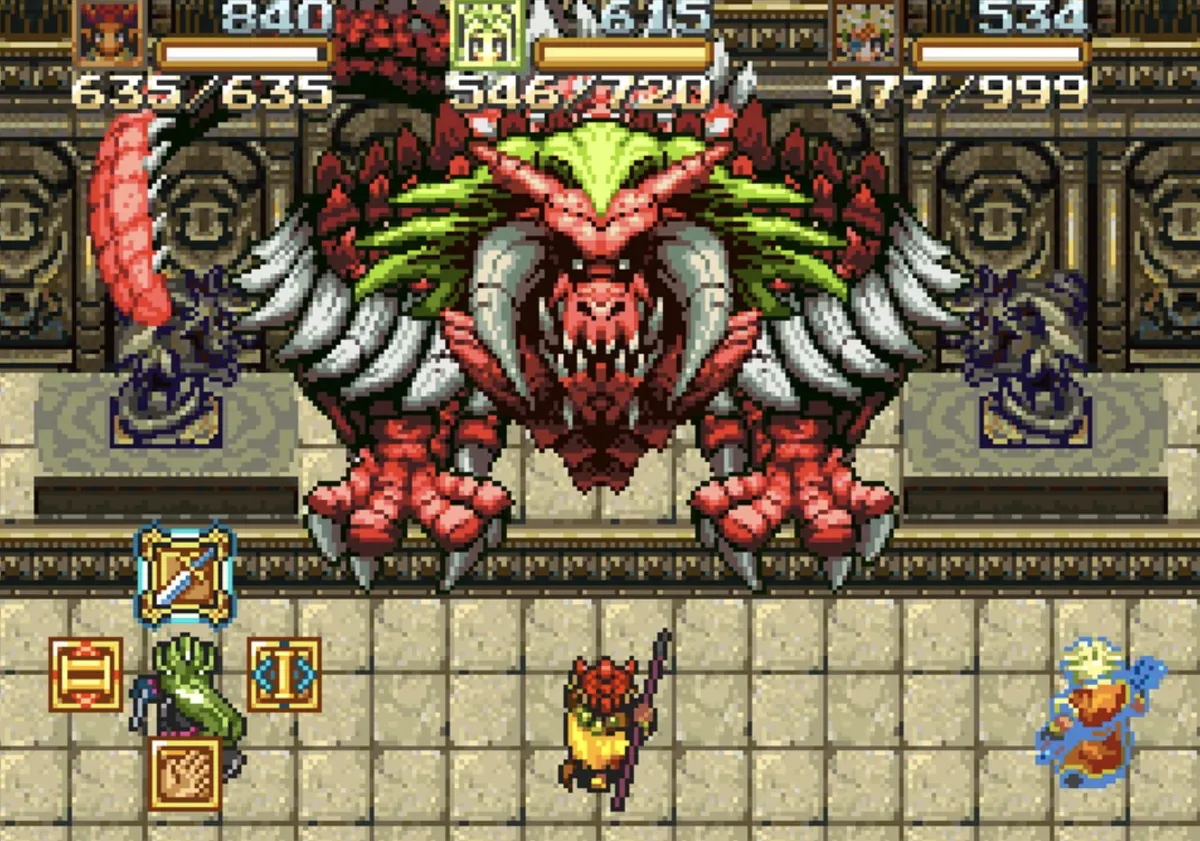
Oh boy, Black Sigil's random battles. These things are a legitimate game killer. If you could turn off combat entirely but keep everything else intact, I'd wager Sigil would make a real impression on a lot of people. But when the experience is so focused on exploration, yet you literally can't walk more than five steps before a random battle interrupts, and when that battle isn't fast or challenging or interesting, a textbook recipe for frustration emerges. I was ready to throw Black Sigil out the window after two hours, all because I couldn't stand the insanely high encounter rate.
Battles are turn-based and lightly tactical in nature, with character position playing a huge role in which attacks you can use against which enemies. Each party member has an action bar that slowly fills up over time. You then choose between physical, magic, and combo attacks, or item usage. You can also run from battles and move your character around the screen, though these features aren't obvious until you start fiddling with buttons on your own.
Each time you enter a battle your first job is to move characters to a smart location. An infuriating aspect of this is the terrain usually creates choke points and party members can't pass through each other. In fact, their hit boxes are gigantic, not bound by visible pixels in the slightest. Even though you should move characters to optimal locations, most of the time you're stuck where you spawn. This means you can't just hold the A button and watch enemies crumble, you have to pick attacks that actually hit. Combat becomes mindful in the wrong kind of way, forcing you to pay attention because you're inconvenienced, not because you're engaged in what happens.
Making all of this worse is the fact that random encounters are so frickin' frequent. Think for a moment how often you'd be willing to run into battles in a 16-bit JRPG. How many steps or seconds between fights feels comfortable? I usually prefer RPGs that don't have battles that pop out of nowhere, but when they do, I want enough time in between to explore a little, you know? Develop a good rhythm between action and silence. A few minutes' pause at least.
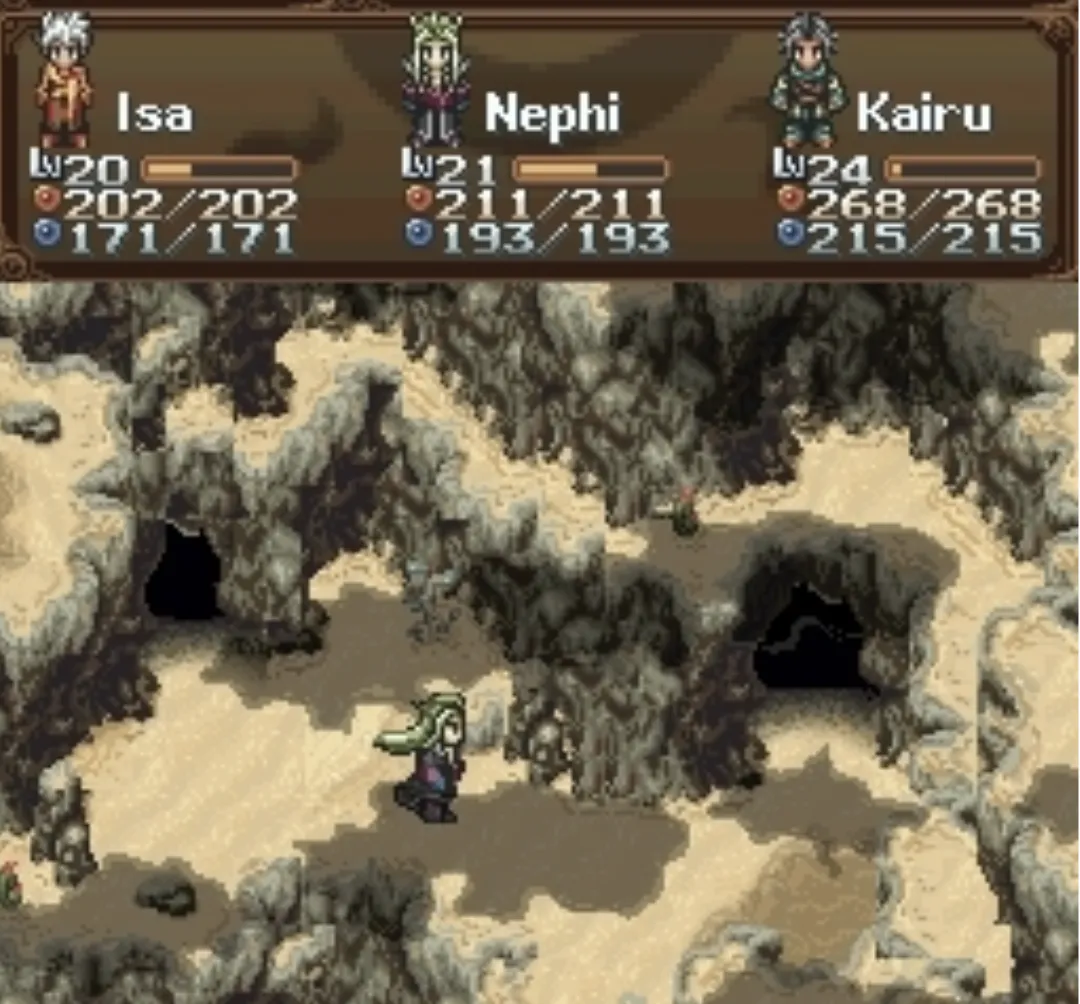
Black Sigil laughs at your idea of well-paced battles. After finishing a fight, expect about 10-15 seconds before your next encounter. That translates to a dozen in-game steps, which doesn't even get you across the screen. For reference, if you completed a battle at the start of this paragraph, you would enter another one as soon as you finish this sentence. Now do that every 15 seconds for the entirety of a 30-hour RPG.
This was why I was ready to put Black Sigil down so early. The artwork, the storytelling, the secrets and the explorable world...all of those things really pulled me in. But mix in super frequent battles I don't want to fight through and it becomes an exercise in "putting up with" the game instead of enjoying it. And I hadn't even run into any of the glitches or softlocks other players reported.
Instead of giving up, though, an idea struck: ROM hacks. Surely someone modified the game to drop the encounter rate. It's too unbelievably high to have gone 15 years without anyone saying "enough of that." And if there's no ROM hack, I could still grab a ROM and find some cheat codes to take the edge off of those battles. I just couldn't give up on the game so easily.
It took one search to find exactly what I wanted--the "reasonable encounter rate" patch from ThegreatBen. This delightful fix drops encounters by two thirds and adds a 2x XP boost. It's still a touch more frequent than I prefer, but it's night and day compared to vanilla. Suddenly I can actually explore the game, look for a path to that treasure chest, and not feel punished for missing the path forward that was hidden behind foreground rocks. All of the good things about Black Sigil are cleanly present, now, and I charged forward for an adventure that ended up feeling like nostalgia made new.
I'm baffled Black Sigil went out the door with an encounter rate this absurdly high. One interview claimed it was an anti-piracy feature, but if that's the case, why was it switched on for release-day physical copies? Did somebody forget to toggle a flag? Other bugs and glitches, even severe ones, are forgiveable given the team's small size. It's just...how did this happen?!
In 2024 we got another layer of info about Black Sigil's early development. A prototype for the GBA version was discovered and dumped for the public to check out. The ROM was dated two years before the 2009 release, and it shows a remarkably complete game that's barely any different from the DS version. Assets, menus, UI elements, characters, dialogue, music...it's all the same. Some chapters are missing and a few bits of polish are absent, but it's clear to see not much changed between the GBA and the DS.
You know what else is unchanged? The encounter rate. It seems this was part of the experience the entire time.
-*-
Hack-fixable issue aside, Black Sigil did a tremendous job delivering an imperfect but good time. You can chart all of its pros and cons, successes and failures on a spreadsheet, but the final experience is more than just "X out of 5 stars." Black Sigil's flaws feel human. Just like none of us have perfect hair or blemish-free skin, Black Sigil, too, has its scars. They make it a better game somehow, and I'm more than willing to grin at those oddities since the rest of the game is so enchanting.
And it really is, too--enchanting. A sequel was planned but ultimately canned as the studio dissolved soon after. I like that there was enough steam behind the release powering the team's confidence to get this one started. I think Black Sigil 2 would have been phenomenal. Just, you know, build in some kind of random encounter toggle.
Years later, one of the core members of the Black Sigil development team started another studio and released a tactical RPG for PC called Fell Seal: Arbiter's Mark. I'm curious enough to check it out, even though tactical RPGs aren't my thing. Something about that x-factor behind the Black Sigil experience makes me want to give it a try.
Other things I wanted to mention:
- Despite all of my searching, I maybe grabbed 70% of the hidden treasure in the game. I love that there's more I could go and find.
- There's no visual or audio cue to battles beginning. The screen simply fades to black and the battle fades in. I never got used to that.
- Researching the game led me to some great fan-run RPG sites on the smallweb/indieweb. Some of them had completely different takes on the game that, while I disagreed with, still thought were accurate and well-put.
- I can't decide how I feel about the music. There are some genuine bangers, but overall it's just sort of...there.
- There was a room in an early castle filled with treasure. The guard outside said it was the king's personal trove. Shortly after, when the castle was under attack, I returned to find the guard had abandoned his post. The treasure was mine.