I'll do it by hand.
In university I took small jobs in town whenever I could. It was an excuse to get off campus, it meant a little cash in my pocket, and I got to interact with townspeople, most of whom had strong opinions about my school. The jobs were usually one-offs and involved gruntwork of the handyman variety. One day I might be hauling away piles of old boards, the next repairing a shed or cleaning out a basement.
Once I was working with a gent from school to replace floorboards in the closet of an old house. It was a simple carpet thrown over 2x4s, so all we had to do was remove screws, swap boards, and attach. The screw removal process was involved, though, as whoever had built this floor apparently thought 20 screws per board was the norm.
I sat on the floor of this dusty closet with my work pal, each of us removing screws one by one. The homeowner had given us two tools: a plain old screwdriver and a battery powered drill. I had the former, and as we worked, each of us commented on our methods' pros and cons. His was faster but more prone to error (and the errors were larger). Mine was easier to control, but slow and painstaking.
We both said we preferred the manual method, and we even swapped when removing boards from another closet. Why the preference? Because the screwdriver connected us to what we were doing, while the drill separated us. You felt every turn with the former. The latter, it was over too fast to know what was going on.
This reminded me of a section of Paul Kingsnorth's Against the Machine. Paraphrased:
Simple technologies were not much used by the ancient Egyptians. The issue was not a lack of knowledge but a concern about what their use might do to the shape of reality. To them, even simple technologies had moral and cosmic implications, as using them required treating matter as if it were no longer the dwelling place of spirit, but as if it were simply mass with little more to it than extension, density and weight.
I'd never thought there were gods in objects, but I did think there was something different about manual, hand-to-object interactions. I could feel it that day with the screwdriver, and I notice it now whenever I pick up a tool. Battery-powered grass trimmer? No thanks. Give me the little pincer thing that goes snik. There's something deeply satisfying about that action, that sound, the time it requires, the muscles involved, the senses it engages.
What about efficiency? Can't I cut more grass faster and with less effort using a machine? I suppose so, but what's the point? To finish what I'm doing or to do what I'm doing?
Tools give us new abilities, and they make tasks easier/less harmful for us. You're not going to hammer nails with your first or go diving without goggles. But our tools are so good they replace our interactions with shortcuts to the end. Shortcuts necessarily cut out something, though, and that something might just be important.
But for human-level jobs, tools feel like they can distort what we're doing and remove us from the process. It becomes about getting to a destination rather than the job itself. And when you're that goal-driven, the only thing you can do after you reach the goal is to set another and start working towards it. Don't pause to appreciate or reflect, just go go go.
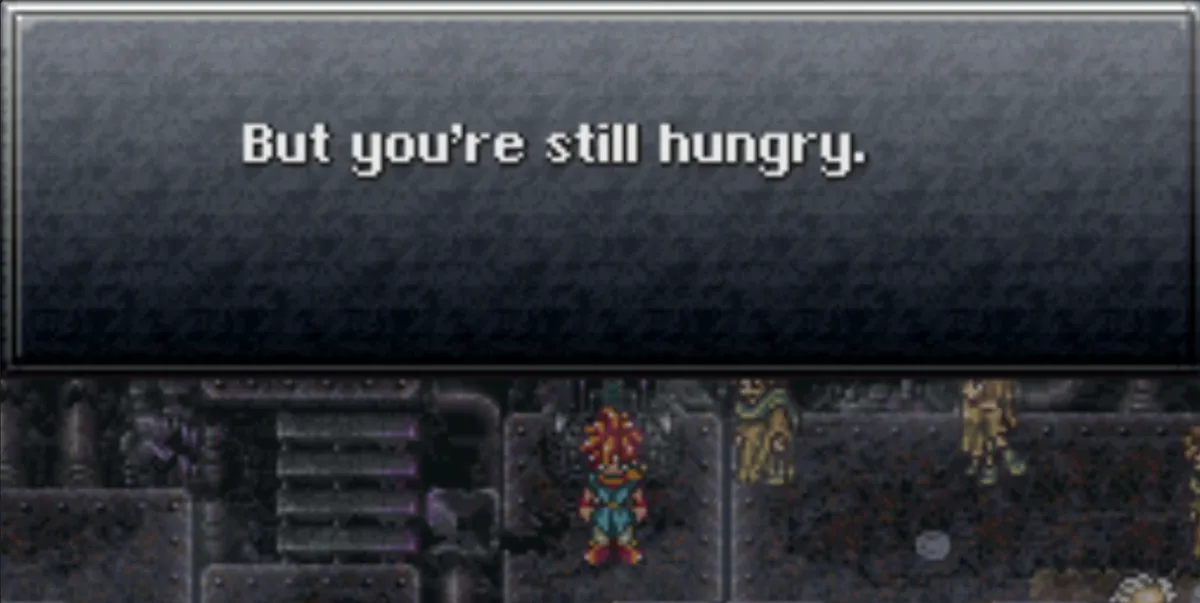
I've had the same feeling about work, hobbies, tasks of any kind. All this AI stuff got me thinking about it, too. The process of doing (and failing at, and mastering) something is pushed aside in favor of being at the final product. Faster, cheaper, easier...but you're never done, are you? And even if you are, you're never satisfied.
Chrono Trigger 30 years ago:
We've got some great tools at our disposal these days. But don't confuse the tools with the thing you want to do. I'm embarrassed to think about how many times I've needed a lightweight notes app only to spend two hours finding just the right one. I should have just picked up a pad of paper, shouldn't I?